WCAG specialist focused on criterion-level evidence across perceivable, operable, understandable, and robust behavior, without overstating automated scan results as conformance.
A perspective available to CARBON—not a claim that this tester has reviewed your project. Findings require execution evidence.
Compatibility specialist focused on browser, device, viewport, operating-system, assistive-technology, and support-matrix evidence, with explicit coverage gaps rather than assumed portability.
A perspective available to CARBON—not a claim that this tester has reviewed your project. Findings require execution evidence.
Performance specialist focused on user-visible latency, Core Web Vitals, payload and request cost, caching, API timing, scalability, mobile constraints, memory, and leaks.
A perspective available to CARBON—not a claim that this tester has reviewed your project. Findings require execution evidence.
Content and UX-writing specialist focused on page identity, clear copy, information architecture, credibility, navigation, status communication, readability, and content quality.
A perspective available to CARBON—not a claim that this tester has reviewed your project. Findings require execution evidence.
Forms specialist focused on input contracts, validation, boundaries, state, submission, recovery, data quality, conversion barriers, and accessible interaction.
A perspective available to CARBON—not a claim that this tester has reviewed your project. Findings require execution evidence.
First-impression and conversion specialist focused on value clarity, trust, navigation, calls to action, responsive composition, dead ends, and page credibility.
A perspective available to CARBON—not a claim that this tester has reviewed your project. Findings require execution evidence.
Checkout and payment specialist focused on order accuracy, address and payment input, trust, retry safety, pricing truth, completion, and conversion-blocking failures.
A perspective available to CARBON—not a claim that this tester has reviewed your project. Findings require execution evidence.
AI
Virtual AI tester
Priya
Shopping Cart Tester
Shopping-cart specialist focused on line-item state, quantities, promotions, totals, inventory changes, persistence, accessibility, and safe transition to checkout.
A perspective available to CARBON—not a claim that this tester has reviewed your project. Findings require execution evidence.
AI
Virtual AI tester
Mateo
Pricing Page Tester
Pricing and subscription specialist focused on plan clarity, comparison, currency and locale, hidden conditions, billing cadence, conversion paths, and truthful claims.
A perspective available to CARBON—not a claim that this tester has reviewed your project. Findings require execution evidence.
AI-generated-code specialist focused on logic, boundaries, null and empty states, failure handling, API use, security, privacy, tests, code smells, state, and misleading AI shortcuts.
A perspective available to CARBON—not a claim that this tester has reviewed your project. Findings require execution evidence.
Click Delete. The record disappears. Did the data?
Maybe it is still in browser storage. Maybe search can still find it.
Maybe an analytics event already sent its contents somewhere else.
That is why I think AI-guided privacy testing is a much better
approach than stopping at a cookie scan or checking that a privacy
policy exists. The interesting work is following what the application
does with information, across screens, requests, accounts, and time.
CARBON brings that investigation into the AI coding agent where you
are building the product. Install it in Claude, Codex, or Cursor from testers.ai/carbon, then run:
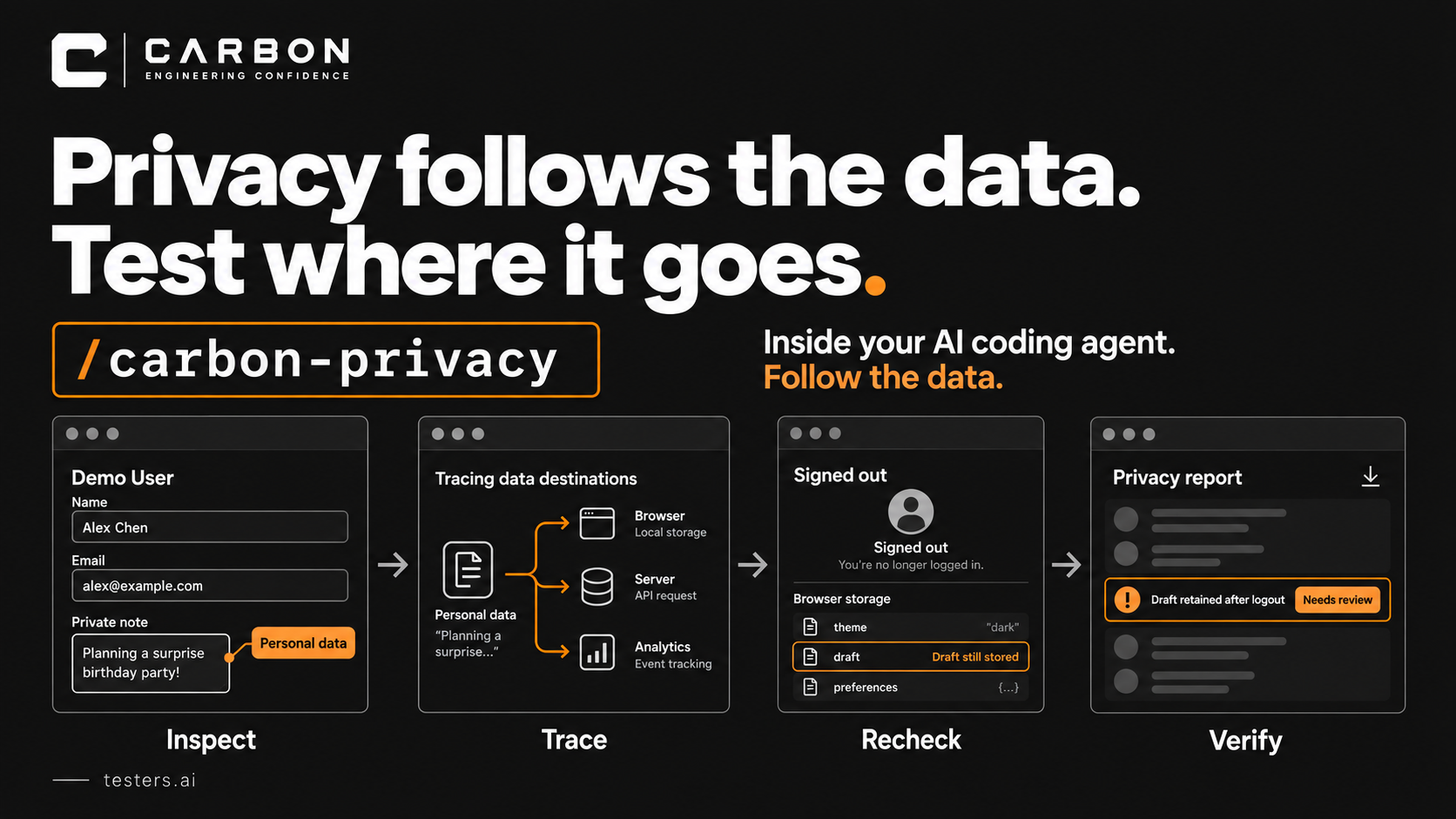
/carbon-privacy
You can start with one feature. You do not need to wait for someone
to organize a company-wide privacy exercise.
Follow one piece of
information
Imagine a customer enters a name and a private note into your
application.
The form saves correctly. The detail page looks right. Your
functional test passes.
Now follow the note. Did it end up in a URL? Does search telemetry
include it? Is it copied into an error report? Does it remain in a draft
after logout? If another account signs in on that browser, what can it
see?
No attacker has to break in for those to become privacy problems. The
application may be doing exactly what its code says, while handling
information in ways its users would never expect.
An AI-guided investigation can use the source to identify possible
data paths, then exercise the reachable ones with synthetic information.
A distinctive test value gives the agent something to look for in
storage, requests, logs, and exports.
That turns a general concern into a specific question with evidence
behind it.
What CARBON can help
investigate
Collection and purpose. Compare the information
requested with the task the user is trying to complete and the product's
stated purpose. Flag unnecessary fields and ask about business
requirements the code cannot explain.
Tracking and consent behavior. Inspect requests and
storage before and after consent choices. Check what happens when
someone rejects tracking, changes a preference, or returns later. The
banner's appearance does not establish what the application does.
Logout and account switching. Look for personal
information left in drafts, caches, browser storage, and already-open
tabs. Then examine what happens when another controlled test account
signs in.
Correction, export, and deletion. Change or delete
synthetic records and follow the effects through the surfaces available
to inspect. A record disappearing from one page does not establish that
its other copies are gone.
Unexpected recipients. Inspect whether personal
data reaches analytics, crash reporting, notifications, support tools,
or AI prompts beyond the intended scope. Check both the implementation
and observed traffic where access permits.
AI can adapt this investigation to the product rather than treating
every site as the same collection of forms. It can also compare the
behavior it observes with the promises in the interface and
documentation.
Read what the screen
promises
Visual analysis matters here too.
Can someone find the rejection option? Is the deletion explanation
clear about what happens next? Does the interface say “deleted” when the
action only archives the record? Does a sharing dialog communicate who
can see the information?
AI can examine the rendered experience and point out inconsistencies
worth investigating. But a screenshot of a consent banner cannot prove
that tracking stopped. That needs behavioral evidence.
The useful combination is the promise, the implementation, and the
observed result.
A privacy report with a
trail to follow
CARBON generates a privacy report that should explain what was
tested, which data paths were observed, what went wrong, and what to
verify after a fix. It can turn technical evidence into an explanation a
developer or product owner can use.
The limits need to remain visible. If the agent cannot inspect
backups or a third-party system, it cannot claim that deletion reached
them. Seeing no external requests during one local journey is useful
evidence about that journey, not proof that the deployed product never
shares data.
Use synthetic records and minimize what the test captures. Sensitive
evidence should be redacted. A privacy test should not create another
copy of the very information it is trying to protect.
This is also not a legal compliance certificate. Whether a purpose,
retention period, or consent mechanism meets an obligation can depend on
facts outside the application. CARBON can surface the unanswered
questions; the people accountable for those decisions still need to
answer them.
Test it before the data is
real
Here is a practical starting point:
/carbon-privacy follow synthetic profile data through save, edit, logout, account switching, and export; plan deletion checks and ask before executing them
Run it while the feature is still being built. Fix the problem, then
follow the data again.
With a subscription coding agent, local testing can use your existing
allowance rather than require a separate per-run model API bill. Limits
and optional external service costs still apply, but the incremental
cost can be very low.
You should not need a customer complaint to discover that their
private note survives logout.
AI makes the investigation easier to start. The responsibility was
already yours.