
/proof
Automatically select a consequential code property and attempt bounded local Lean verification with CARBON.
 Jay · Your AI test managerProof & release confidence
When to use it
A consequential code property has a small, supported formal scope.
Before you start
Bare /proof ranks source-grounded candidates and attempts one supported property automatically. Lean is required. Toolchain installation needs approval. Supported restricted Python Boolean and finite JavaScript state-transition models are not general proofs of arbitrary application code.
Try this in your coding agent.
/proof Inspect src/orders/state.js and attempt a Lean-backed proof of our documented order-transition rules. Keep unsupported behavior explicit.Replace sample paths with your project. Slash names are shorthand; your host may use a plugin prefix or a skill picker. Invocation help →
Read the verdict precisely.
- PROVED
- The recorded model property holds in its stated domain under its assumptions.
- COUNTEREXAMPLE
- A concrete failure has replay evidence. Preserve the input and regression fixture.
- UNPROVED
- Unsupported semantics, missing Lean/isolation, unresolved obligations or budget exhaustion. Not automatically a bug.
- STALE
- The fingerprint or dependencies changed. Fresh preparation and checking are needed.
Lean is mandatory: no native-only fallback. New toolchain downloads/container setup need explicit permission. Default automatic verification is one bounded attempt; manual selection is opt-in. A successful setup or generated Lean file is not a proof result.
Illustrative Lean: a tiny status model
This teaching example is not runtime-generated output or proof of the application. It only demonstrates the shape of a narrow model claim.
inductive Status where
  | pending | paid | shipped | cancelled
  deriving DecidableEq

def allowed (a b : Status) : Bool :=
  match a, b with
  | .pending, .paid => true
  | .pending, .cancelled => true
  | .paid, .shipped => true
  | _, _ => false

theorem cancelled_stays_closed (next : Status) :
    allowed .cancelled next = false := by
  cases next <;> rfl
ILLUSTRATIVE WALKTHROUGH
Order-status transition contract
An expanded teaching example, not a recorded or live execution. The report stays visible while the replay explains how to read it.
- 01Rank targets
- 02State the contract
- 03Build Lean model
- 04Check + replay
- 05Qualify the result
Coding-agent conversation

Example report
Illustration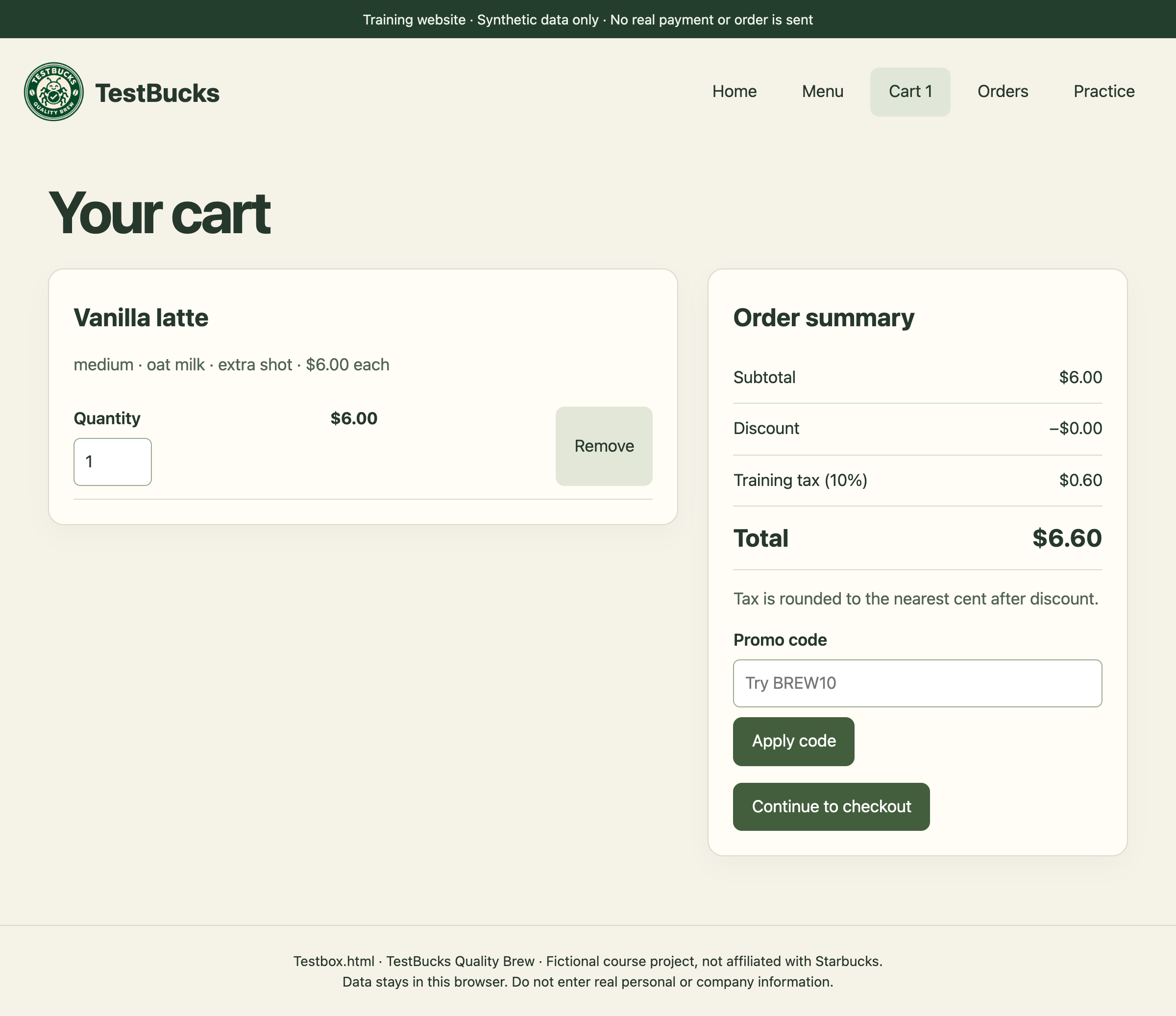
TestBucks course screen with illustrative analysis. The screenshot supplies context; the demo does not establish a newly observed bug.
- Order status
- Independent contract
- Qualified model claim
Illustrated outcome
Illustration: only documented one-step order transitions are accepted by the model.
Evidence to inspect
Compare an independent status/transition contract with the selected lookup, guard and status-assignment code. Retain original-source replay separately from the Lean verdict.
Still untested / not established
No Lean compiler runs in this booklet. Source/model equivalence, arbitrary JavaScript, long event sequences, callers and whole-app correctness are not proved.
Ready. Read the full example or play its steps.
What a useful result contains
A bounded claim
For order-status transition contract, state the target, revision, environment and actual work performed. Keep planned, executed, blocked and untested work separate.
An inspectable trail
Compare an independent status/transition contract with the selected lookup, guard and status-assignment code. Retain original-source replay separately from the Lean verdict. In a real run, retain the source, trace, screenshot or fixture behind the conclusion.
The qualification
No Lean compiler runs in this booklet. Source/model equivalence, arbitrary JavaScript, long event sequences, callers and whole-app correctness are not proved.
The next decision
Decide whether the evidence calls for a focused check, a reviewed fix or more context. Do not convert a plausible example into a verified finding.
Adapt the example to your project
- Replace order-status transition contract with a real feature, path or decision in your project.
- State the expected rule and its source. Include safe fixtures, constraints and a budget where appropriate.
- Ask for exact evidence and remaining gaps. Approve consequential actions separately.
/jay Review the /proof result. Separate observed evidence, assumptions and untested scope, then recommend the next useful check.Where to go next
/carbon-test →/carbon-generate →Content checked against the local command definition: skills/proof/SKILL.md. Examples adapted from the homepage’s TestBucks walkthroughs. Availability is edition- and host-dependent.