
/carbon-stress
Review source and server configuration read-only for stress risks, then propose or execute explicitly approved bounded stress and recovery experiments. Prefer isolated local tight-loop/component tests. Require two separate confirmations before any non-localhost stress; never run unbounded exhaustion or silently stress remote dependencies.
 Tariq · PerformanceSecurity & resilience
When to use it
You need to understand behavior beyond normal operating conditions.
Before you start
Prefer isolated local component tests and hard limits. Non-localhost stress needs two separate confirmations. Recovery evidence matters as much as the first failure; unbounded exhaustion is out of scope.
Try this in your coding agent.
/carbon-stress Inspect checkout configuration for resource-exhaustion risks without running a stress test.Replace sample paths with your project. Slash names are shorthand; your host may use a plugin prefix or a skill picker. Invocation help →
ILLUSTRATIVE WALKTHROUGH
Resource-exhaustion readiness
An expanded teaching example, not a recorded or live execution. The report stays visible while the replay explains how to read it.
- 01Read context
- 02Analyze
- 03Show evidence
- 04Report
Coding-agent conversation

Example report
Illustration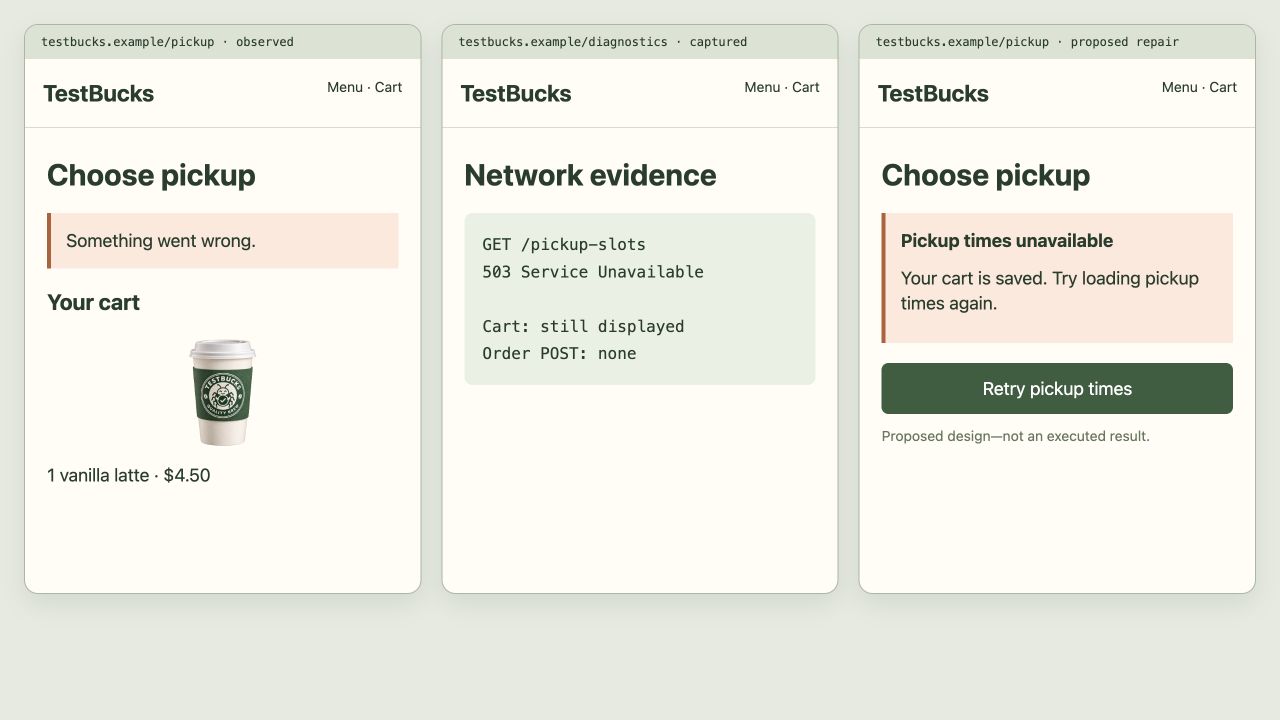
TestBucks course screen with illustrative analysis. The screenshot supplies context; the demo does not establish a newly observed bug.
- Failed request
- Preserved state
- Safe retry
Illustrated outcome
Retries have no cap and can accumulate pending requests.
Evidence to inspect
Configuration trace: retry loop + absent queue bound + no circuit-breaker setting.
Still untested / not established
Read-only review: no stress traffic or outage injection.
Ready. Read the full example or play its steps.
What a useful result contains
A bounded claim
For resource-exhaustion readiness, state the target, revision, environment and actual work performed. Keep planned, executed, blocked and untested work separate.
An inspectable trail
Configuration trace: retry loop + absent queue bound + no circuit-breaker setting. In a real run, retain the source, trace, screenshot or fixture behind the conclusion.
The qualification
Read-only review: no stress traffic or outage injection.
The next decision
Decide whether the evidence calls for a focused check, a reviewed fix or more context. Do not convert a plausible example into a verified finding.
Adapt the example to your project
- Replace resource-exhaustion readiness with a real feature, path or decision in your project.
- State the expected rule and its source. Include safe fixtures, constraints and a budget where appropriate.
- Ask for exact evidence and remaining gaps. Approve consequential actions separately.
/jay Review the /carbon-stress result. Separate observed evidence, assumptions and untested scope, then recommend the next useful check.Where to go next
/carbon-reliability →/carbon-load →Content checked against the local command definition: skills/carbon-stress/SKILL.md. Examples adapted from the homepage’s TestBucks walkthroughs. Availability is edition- and host-dependent.