Before the run
Review the test count, scope, test-level estimates, exclusions, and safety gates. A plan is still a plan: every test remains planned until CARBON records an observed result.
Documentation · CARBON
The first AI Agentic Verification Harness. A practical reference for running CARBON inside Claude, Codex, Cursor, Antigravity, ChatGPT, or any local MCP client.
Start here
Open the project folder in your coding agent so CARBON can see the relevant code, requirements, tests, results, screenshots, and documentation. CARBON Help recommends the best first workflow without changing anything.
$carbon-help

Claude Code:  /carbon-help
ChatGPT/MCP:  /carbon_help
Natural language: Use CARBON Help to assess this project and tell me what to run next
$carbon-help — read-only project analysis and a prioritized CARBON starting plan.$carbon test this in quick mode — risk-selected local validation of the current change.$carbon-browser test checkout with depth exploration — exercise a reachable browser flow.$carbon-generate all widgets and checkout flows — generate planned coverage without executing it.$carbon-tests add "A signed-out visitor cannot reach billing" — add a prompt-defined intent test.$carbon-human — surface only the decision-changing human questions before a confidence or release call.$carbon-review review these findings and results — independently challenge the evidence.Harness map
Claude, Codex, Cursor, and other MCP clients route test intent into the same CARBON runtime. CARBON keeps local execution as the default and separates optional testers.ai Premium Cloud capabilities behind an explicit path.
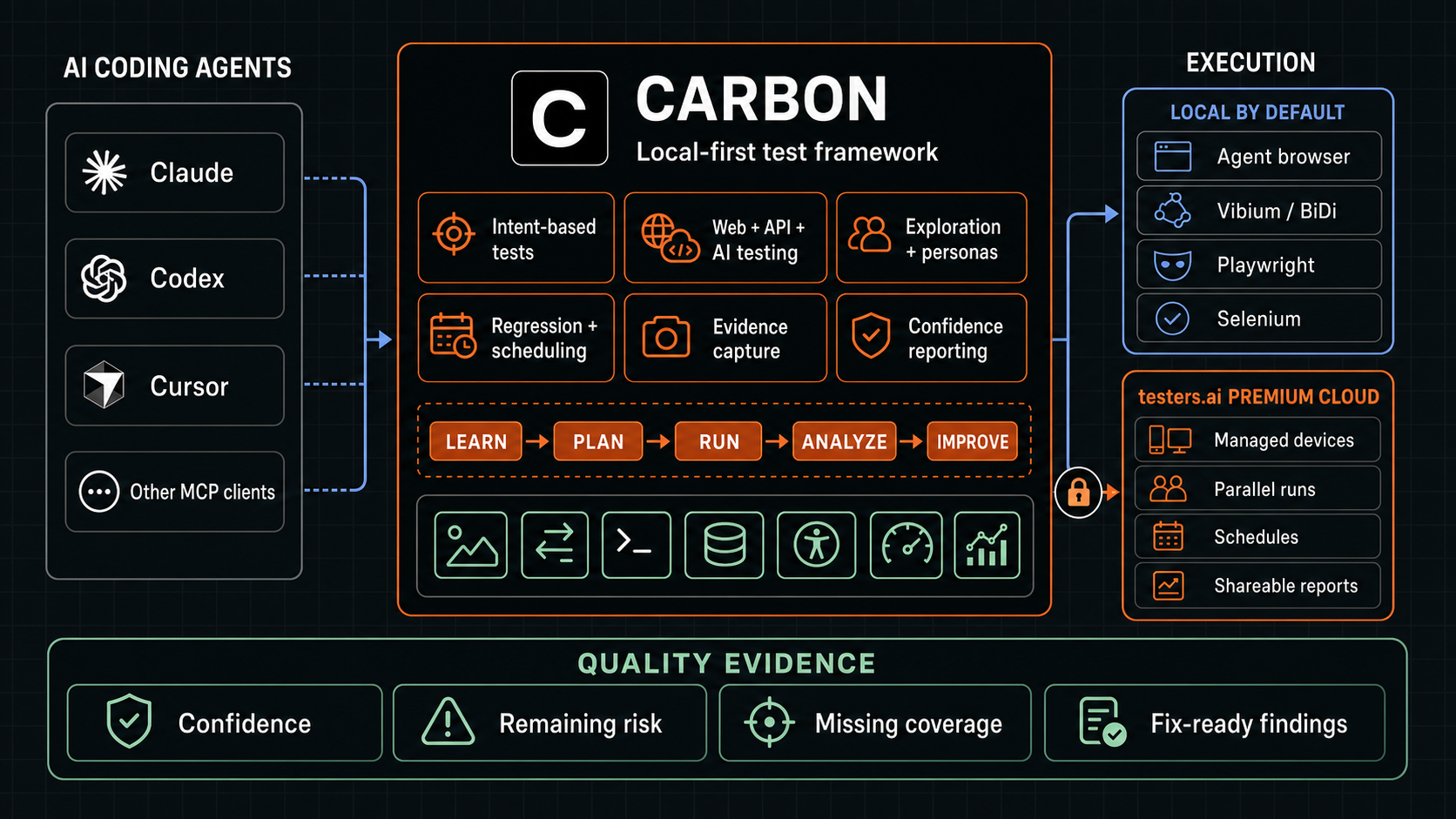
Before execution
For an executable local run, CARBON first prepares the test plan and opens a protected link on your computer. The page shows the target, selected breadth or depth, exact tests, priorities, adapters, approval gates, stop conditions, and the initial estimated duration before execution begins.
Review the test count, scope, test-level estimates, exclusions, and safety gates. A plan is still a plan: every test remains planned until CARBON records an observed result.
Keep the same link open. It attaches to the matching durable run automatically and refreshes every second. Status, percent complete, elapsed time, and remaining time update as test evidence arrives.
CARBON Browser v1
carbon-browser/v1 is the stable boundary between CARBON test intent and browser execution. CARBON now includes an executable bridge to the official Vibium CLI and existing Vibium tests. Other host-agent, Playwright/CDP, Selenium/WebDriver, and managed-device integrations use the same capability contract when their execution bridges are available.
Each adapter declares its operations and evidence channels. CARBON compares those capabilities with the planned run before dispatch. A missing operation, screenshot, network log, trace, or video remains a visible gap; CARBON selects another adapter or explicitly re-plans a smaller run.
Every operation returns actual behavior, before/after state, timestamps, adapter identity and version, evidence handles, and unavailable channels. CARBON stores redacted envelopes under .carbon/browser/sessions/ and applies the same E0–E3 truth model used by the rest of the framework.
bin/carbon-runtime browser contract
bin/carbon-runtime browser negotiate --manifest adapter.json \
  --require-operation action.click --require-evidence screenshot
bin/carbon-runtime browser init --root . --manifest adapter.json --target https://your-site.example
bin/carbon-runtime browser record --session-dir .carbon/browser/sessions/<id> --result result.json
Executable compatibility
CARBON calls the official installed vibium binary and preserves native arguments. It can also run existing JavaScript or Python Vibium tests, or any explicit no-shell project runner. Every invocation records its exit status, redacted output, adapter version, artifact handles, and unavailable evidence channels in a CARBON Browser session.
bin/carbon-runtime vibium doctor --root .
bin/carbon-runtime vibium exec --root . -- go https://your-site.example
bin/carbon-runtime vibium exec --root . -- map
bin/carbon-runtime vibium run-test --root . --file tests/login.vibium.mjs
bin/carbon-runtime vibium generate --root . --target https://your-site.example \
  --vibium-map artifacts/page.map.txt --request "Generate boundary and recovery tests"
The carbon_vibium MCP API supports api, doctor, manifest, exec, run-test, and generate. A missing binary is not installed unless the caller explicitly allows the npx fallback.
CARBON adds prompt and project-aware generation, intent CRUD and legacy imports, exploratory and persona testing, API and AI-feature tests, evidence analysis, regression promotion, quality confidence, remaining risk, and visual reports.
Hosts
| Host | Main command | Example |
|---|---|---|
| Codex | $carbon-help | $carbon-help |
| Claude Code | /carbon-help | /carbon-help |
| ChatGPT or MCP prompt | /carbon_help | /carbon_help |
| Cursor or Antigravity | Natural language | Use CARBON Help to assess this project and recommend next steps |
Specialized workflows follow the same mapping: /carbon_tests in ChatGPT or MCP, $carbon-tests in Codex, and /carbon-tests in Claude Code.
Core workflows
| Workflow | Use it for | Durable result |
|---|---|---|
carbon_help | Analyze the current project and change, then recommend the best CARBON workflow and next steps. | No project mutation; a read-only project-fit summary and prioritized starting plan. |
carbon | Automatic product/change mapping, protected live pre-run plan, Plan, Test, Review, Focused, Learn, recording and playback. | A plan link and adaptive estimate before execution, then runs, learning, recordings, framework state and reports under .carbon/. |
carbon_browser | Local live-page inspection, interaction, accessibility, persona feedback and exploration. | Observed page evidence, findings, screenshots and fix prompts. |
carbon_generate | Generate from discovered controls, built-in flows, code contracts, recordings and custom flows. | Prioritized planned candidates with provenance and oracles. |
carbon_tests | Create tests from prompts; open local CRUD UI; import TestRail, Xray, XML, XLSX, DOCX, code, and manual suites; run a full bake; repair converted test definitions; rerun. | Intent library plus attempts, repairs, evidence, activation decisions, and responsive reports under .carbon/tests/bake-runs/. |
carbon_auto | Bounded test-fix-retest loops with explicit stop conditions. | Cycle state, evidence and proposed fixes; no mutation without approval. |
carbon_upgrade | Modernize Selenium, Playwright, Cypress, pytest, JUnit, TestRail, Xray, spreadsheets and manual tests. | Assessment, converted intent, full local bake, bounded definition repair, and evidence-backed results. |
carbon_settings | Configure a global local-test username/password, reusable prompt, context documents, or say mute all ads. | Protected settings UI; the password reaches only an approved child runner and never enters chat or reports. |
carbon_human | Ask only the human questions that can materially change test priorities, confidence, readiness, or release interpretation. | Durable HUM-* decision context and answered assumptions under .carbon/human/. |
carbon_settings to configure one username/password, reusable execution prompt, and document set across CARBON projects. The password stays in Keychain or a locked file and reaches only an approved child runner; the coding agent sees only that it is configured.AI systems
CARBON operationalizes uncertainty, oracles, judges, statistical design, AI systems, generated software, bias, security, operations, and specialized systems. Use these workflows for prompts, models, RAG, ranking, agents, multimodal features, and AI-generated changes.
| Workflow | Purpose |
|---|---|
carbon_confidence | Route a trust or ship question to planning, evaluation, review, release, or incident work. |
carbon_confidence_init | Create the durable .confidence/ workspace. |
carbon_confidence_plan | Map risks, falsifiable claims, populations, decision-changing evidence, monitoring and rollback. |
carbon_eval | Design, implement, run and analyze sampled evaluations. |
carbon_review | Independently challenge code, behavior, assumptions, interactions and evidence. |
carbon_release | Decide SHIP, CANARY, HOLD, ROLL BACK or MORE EVIDENCE. |
carbon_incident | Contain an AI incident, preserve traces and promote production failures into regressions. |
carbon_eval_design_review | Review populations, cases, repetitions, oracles, dependence and blockers. |
carbon_release_review | Independently synthesize code, evals, severe failures, production signals and reversibility. |
carbon_security_review | Review prompt injection, untrusted channels, leakage, tenant boundaries, tool permissions and side effects. |
carbon_skeptical_review | Find weak evidence, misleading averages, hidden severe failures and confidence theater. |
carbon_statistical_review | Review pairing, ordinal scores, clusters, repetitions, intervals, multiplicity and practical significance. |
Human decision context
CARBON can inspect source, execute authorized checks, and qualify the evidence it captures. It cannot silently decide business intent, risk appetite, taste, accountability, or whether a technically correct experience solves a customer’s real problem. Near the end of a broad run, CARBON can therefore add an optional Human step. It does not block technical confidence; it makes the missing human context visible.
CARBON generates a short, project-specific set of questions only when an answer could change an oracle, test priority, safety boundary, or release decision. It avoids generic checklists and questions already answered by the code, requirements, or captured evidence.
Questions remain open until answered. CARBON opens a protected workspace beside chat with quick options, room for nuance, and comments on every question or the overall decision. Every save remains local and refreshes the branded report snapshot.
$carbon-human
$carbon-human answer HUM-003: Production launch; incorrect billing totals must hold release.

Decision context: .carbon/human/decision-context.json
Private feedback loop
$carbon-feedback creates a scoped feedback request around a URL, image, document, API, code surface, or any other artifact. It opens a polished local workspace beside the coding agent so a developer can quickly score, categorize, explain, and annotate what they see. The resulting feedback is durable local context for CARBON’s next plan, confidence interpretation, or focused test pass.
The default loop stays under .carbon/feedback/requests.json. It does not upload browser state, source, raw agent context, credentials, or feedback to a public CARBON service. Returned feedback is qualitative evidence, not a synthetic technical pass.
For a named external reviewer, deploy the bundled private Feedback Service in your own environment. CARBON sends only the selected request after the owner explicitly confirms the endpoint, recipient, artifact, and context. The service has queued state, capability links, and a responsive reviewer form.
$carbon-feedback review this checkout page for first-time-customer trust and clarity
$carbon-feedback ask Priya to review this staging URL for whether the primary value is clear
Execution
| Mode | What CARBON does |
|---|---|
| Plan | Creates a prioritized suite and execution plan without claiming runtime evidence. |
| Test | Exercises an authorized reachable target and records observed results. |
| Review | Inspects source, screenshots, specifications or diffs and labels executable hypotheses. |
| Focused | Loads only the named behavior, matching flow, evidenced controls and shared oracles. |
| Learn | Discovers unfamiliar behavior and keeps hypotheses separate from supported candidates. |
Coverage map
CARBON combines functional, data, experience, security, performance, exploratory, AI-system, and evidence coverage. The map below shows how those checks connect to confidence, remaining risk, coverage gaps, and fix-ready findings.
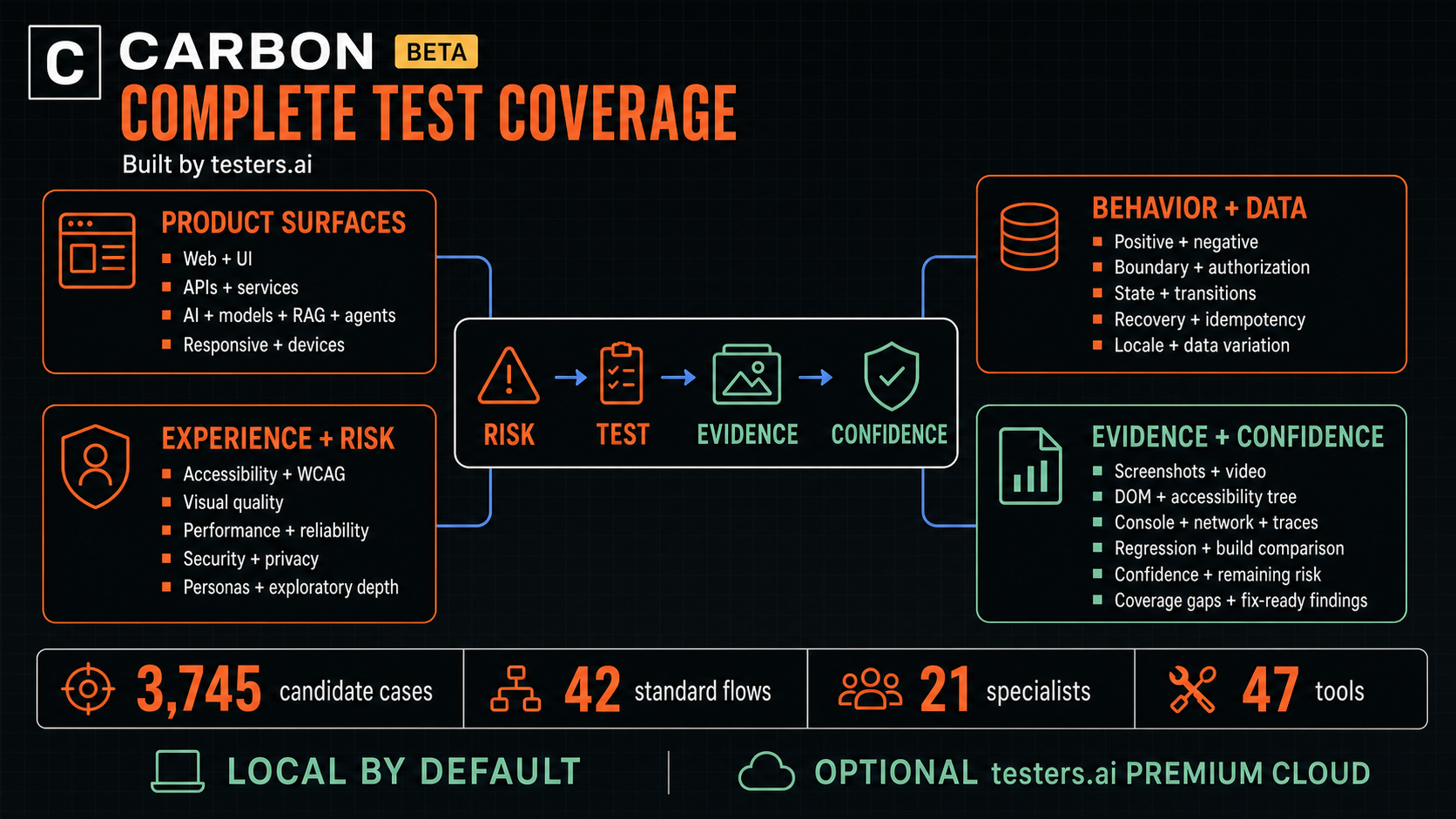
Truth model
| Level | Meaning | Allowed claim |
|---|---|---|
| E3 | Observed live behavior with reproducible steps and captured actual result. | Executed pass or failure within the recorded scope. |
| E2 | Source, request or log evidence corroborated by rendered state. | Corroborated finding, not full end-to-end proof. |
| E1 | Inspected source, screenshot or specification. | Finding or candidate test. |
| E0 | Unknown or unavailable. | Planned, blocked or residual uncertainty. |
CARBON reports confidence in quality for the selected, executed scope; remaining risk; conclusive and evidence-backed coverage; coverage missing; and the next evidence that would change confidence. Planned, blocked, skipped, canceled, unsupported and excluded checks remain visible instead of being blended into a reassuring score.
candidate to observed to repeatable and only then to an explicitly promoted regression.Surfaces
CARBON records the richest safely available bundle: screenshot, URL/title/viewport, DOM and accessibility state, console and page errors, bounded redacted network traffic, performance, synthetic data, storage-safe metadata, traces, recordings and video. Unavailable channels remain explicit gaps.
CARBON can learn from OpenAPI documents and authorized redacted traffic, then generate positive, negative, boundary, wrong-type, auth, tenant, idempotency, retry and resilience cases. It maps API failures back to the UI flows that depend on them.
$carbon map the OpenAPI schema and test the changed checkout endpoints
$carbon-browser test checkout and connect network failures to visible UI states
Continuous confidence
The framework maps recent code changes to affected components, APIs, flows and adjacent regressions. It can prepare Quick, Medium or Large execution based on assessed risk, install a GitHub Actions workflow after approval, and maintain build history.
carbon_auto: bounded local test-fix-retest loop with approval before mutation.testers_schedule: recurring premium cloud execution tied to an owned report.Project state
.carbon/
├── framework/     product model, coverage, regression suite, build history
├── runs/          plans, results, events, findings, evidence and reports
├── learning/      unfamiliar-surface observations and candidates
├── recordings/    redacted browser steps, assertions and playback outcomes
├── tests/         prompt-defined and converted AI-intent tests
│   └── bake-runs/ attempts, repairs, evidence and responsive import reports
└── auto/          bounded loop state and stop reasons

.confidence/
├── risks/         material risks and affected populations
├── claims/        falsifiable behavioral claims
├── evals/         evaluation definitions and results
├── traces/        prompt, model, retrieval, tool and decision evidence
└── releases/      scoped ship/canary/hold/rollback decisions
Optional premium
Local carbon workflows use the coding agent and project context. Commands beginning with testers contact testers.ai Premium Cloud and never run automatically from a local workflow.
| Workflow | Purpose |
|---|---|
testers_plan | Create an editable risk-steered plan for a public URL. |
testers_run | Run targeted, full-site, managed-browser or chatbot validation. |
testers_results | Retrieve cloud findings, evidence, scores and fix-ready prompts. |
testers_import | Persist an explicitly approved test batch to the account. |
testers_schedule | Create or manage recurring premium validation. |
An email enables the current daily targeted UX pass and weekly two-page sampler routes. Account history, saved cloud tests, schedules and paid execution require a securely stored testers.ai API key.
Authority
carbon_settings or set CARBON_ANALYTICS=off before startup.mute all ads or use carbon_settings. CARBON suppresses optional promotions and removes testers-prefixed tools and prompts from dynamic discovery. Say unmute ads to restore them.