
First, the AI learns the game.
CARBON for Games starts with a learning phase. The AI explores the app, tries the controls, navigates menus and discovers available settings. It observes what happens after each action to learn how to start, play and recover when something goes wrong.
That knowledge becomes a test plan: which player personas to exercise, which goals to pursue, which settings to vary and what outcomes to verify. Learning continues during testing. An unfamiliar screen or unexpected response can send the AI back into exploration. CARBON saves knowledge separately for each game and can revisit it as the app changes.
One game. Two devices. A lot to coordinate.
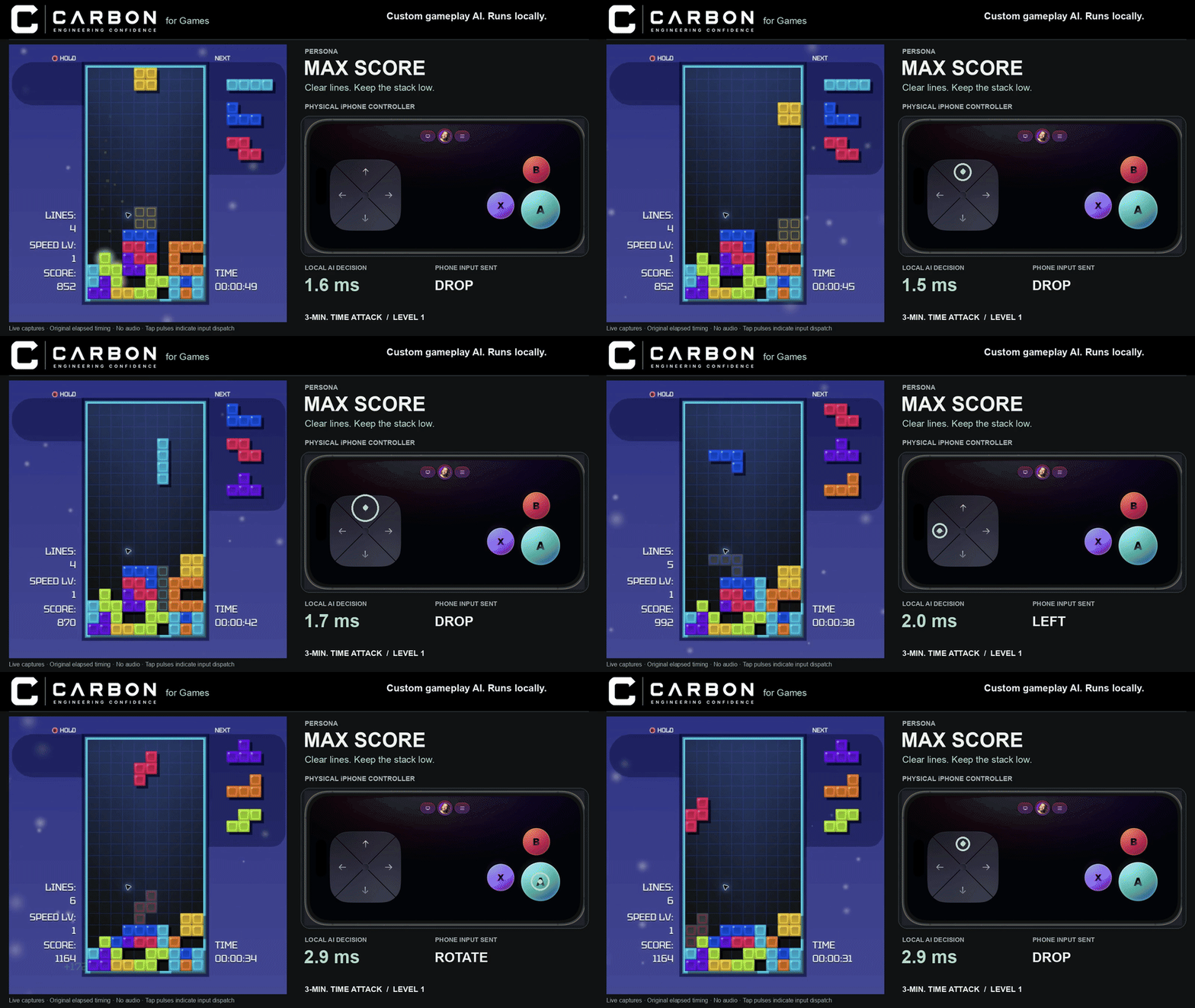
Some Netflix desktop games use a phone as the controller while the game runs in a browser. The AI must coordinate the phone, the browser and the connection between them. In this demo, it operates a physical iPhone paired with Tetris in the desktop browser.
Even getting to the first move takes work. Pairing links expire. A controller can appear connected but stop responding. A session may need a restart or cleared state. Setup, connection recovery and getting back into the game belong in the test plan too.
The game will not wait for the AI.
Gameplay is more demanding than clicking a predictable sequence of buttons. The AI has to understand the current state, choose a useful move, deliver the input and observe the result. In Tetris, a block keeps falling while that happens. A sensible decision delivered too late is still a bad move.
Our custom-trained gameplay model can run locally. In the recorded Max Score run, median model inference was 1.77 milliseconds. The complete observe-and-act loop was much slower: median placement time was 4.56 seconds, with phone input delivery a major bottleneck. Fast reasoning helps, but the whole interaction must keep up.
The visible result: 1,260 points and six lines cleared in a completed three-minute Time Attack round. This is a recorded run, not a promise of the same score every time. Capture gaps are marked in the video.
Custom models, working together with AI.
CARBON uses custom-trained gameplay models for different player personas, working with AI components for other parts of the testing stack: exploration, test design, orchestration and evaluation. They interact through shared observations, plans, decisions and execution evidence to test apps together.
The current Tetris models learn from simulated games and outcome-based training. A selected persona guides gameplay decisions, while the broader AI workflow supplies context and evaluates what happened. The demo uses the local Max Score model; the exploration and evaluation components are separate AI capabilities, not all custom-trained models.
This division lets each part focus on its job: learn the app, create the test plan, choose actions, and verify execution. The useful output is a traceable result backed by what the system actually observed.
Different players expose different problems.
A perfect player can miss problems that a confused beginner finds immediately. CARBON’s testing workflow can explore multiple player styles:
- First timer: discovers controls, misses instructions and makes understandable mistakes.
- Casual player: explores at a relaxed pace without optimizing every move.
- High scorer: pursues points, combinations and efficient placements.
- Speedrunner: looks for quick routes and fewer inputs.
- Rule breaker / cheater: looks for loopholes in visible gameplay mechanics, such as unexpected action sequences or repeatable advantages.
- Edge-case explorer: probes boundaries, interruptions and unusual states.
The local Tetris bundle has trained policies for high score, casual, speedrunner and rule-breaker play. First-time discovery and wider edge-case exploration use the broader testing workflow. Each persona needs its own observed run before we can claim its tests passed.
Personas describe how. Goals define what to test.
A casual player can still test a difficult setting. A high scorer can test recovery after a pause. A test goal might be to complete a round, reach a score, discover every menu, exercise a shortcut or recover from a controller disconnect.
The plan also covers configuration. Does a difficulty change alter gameplay? Does the selected level appear correctly? Does music actually stop when it is turned off? Do settings persist when the player leaves a menu and returns?
Selecting an option is only the first half of that test. The AI must verify its effect using suitable evidence. A silent-looking screenshot cannot establish that music stopped; that check needs audio evidence. Missing evidence should remain an open question.
The most interesting checks are qualitative.
CARBON’s AI can examine more than scores, crashes and completed rounds. Did the player understand what happened? Was feedback timely and helpful? Did the controls feel responsive? Was a recovery path confusing? Did the game behave consistently with the player’s expectations?
These are observations to investigate, with evidence and context—not universal verdicts about what every player will enjoy. Different personas and goals make those questions more useful.
Learn. Plan. Play. Verify. Learn more.
CARBON for Games brings AI into the full testing workflow: learning the app, creating a test plan, executing scenarios with different personas and goals, checking outcomes, and reporting findings. New discoveries can feed back into the next round of learning and testing.
The result is a growing understanding of how the game works and where the player experience needs attention. Playing the game is how we get there.